I wanted to understand how different people are using AI. My hunch is that we all use AI rather differently: some swear by it for all aspects of their lives, others are suspicious of it and only use minimally for menial things they don’t want to do themselves, and yet others use it for deeply personal things, such as confiding and chatting with it almost like one would with a therapist. Part of what motivated this endeavor is my “startup idea” which explores the extent to which our “AI usage” can be substituted or fulfilled by open weight models. My thought process is this: if our core usage patterns can be catalogued, it’ll be way easier to determine whether a particular model - perhaps a more efficient, ‘cheaper’, or greener model - will be able to fulfil our needs. We don’t need to bring out the hammer drill when a screwdriver can do the job. I see this as a current blind spot in consumer awareness, which will be corrected as users of AI are more mature and cognisant of alternatives.
So I began by downloading my entire Claude chat history. Mine turned out to be an 18Mb JSON file. After extracting only two fields of interest - timestamp and text prompt - I began classifying them.
My method of classification is crude, but I think it fulfils what I need, for now. Each conversation is graded according to 3 axes: function, domain, and effort. I’ll first talk about the function axis.
Function refers to the type of conversation that I am having with the AI. For instance, most of my prompts are of the basic “question” type, meaning I expect the AI to be able to search the internet, and give me some kind of answer. If it needs to reason, I tag it a “reasoning” function. If it needs in-depth domain expertise, I attribute it an “expert” function. It’s a crude classification scheme I know. but it helps me think about what kind of role I expect the AI to play in our interaction.
The second axis is the “domain” axis. This reflects the topic of our conversation, such as tech, finance, gardening, etc. The domain is orthoganal to function. A question like “how do I install docker” will have a “question” function type with a “tech” domain, for instance.
Finally, the third axis is related to “effort”. Prompts which require high effort could look something like this: review all the legal cases on copyright law in Singapore in 2026 and summarize for me broad trends. Simpler, low effort ones could go: translate “how are you” to Spanish. Most things belong to the medium category.
So those are the matrices for evaluating conversations.
The result
Between the period of May 2025 to Nov 2026, I had 297 conversations with Claude1. This chart shows my increasing Claude usage over time:
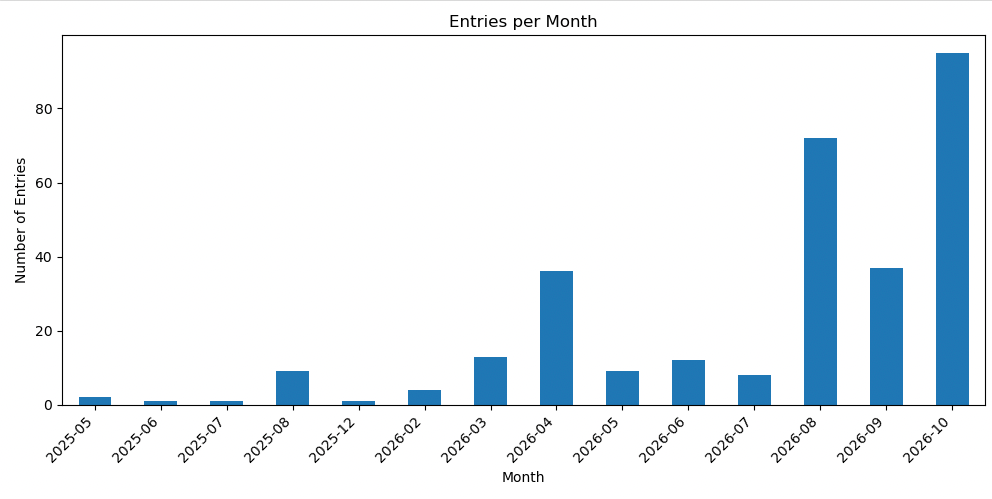
In general, yes, my Claude usage has increased over time. But also, I’d like to caveat that my usage habits also changed. In the beginning, I’d have multiple conversations in one thread, sometimes spanning different topics; whereas now, I spin up a new chat as soon as I detect that the model does not need any context from the current chat.
My habits have become more “AI” native.
So what kind of topics do I use Claude for? A survey of the domains reveals that I m mostly using it for tech related questions:
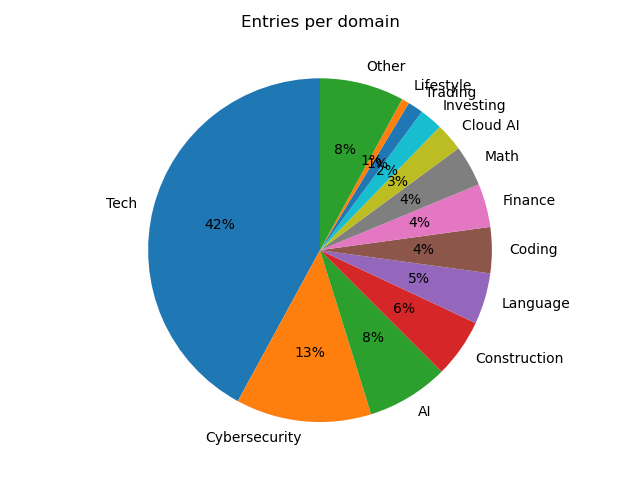
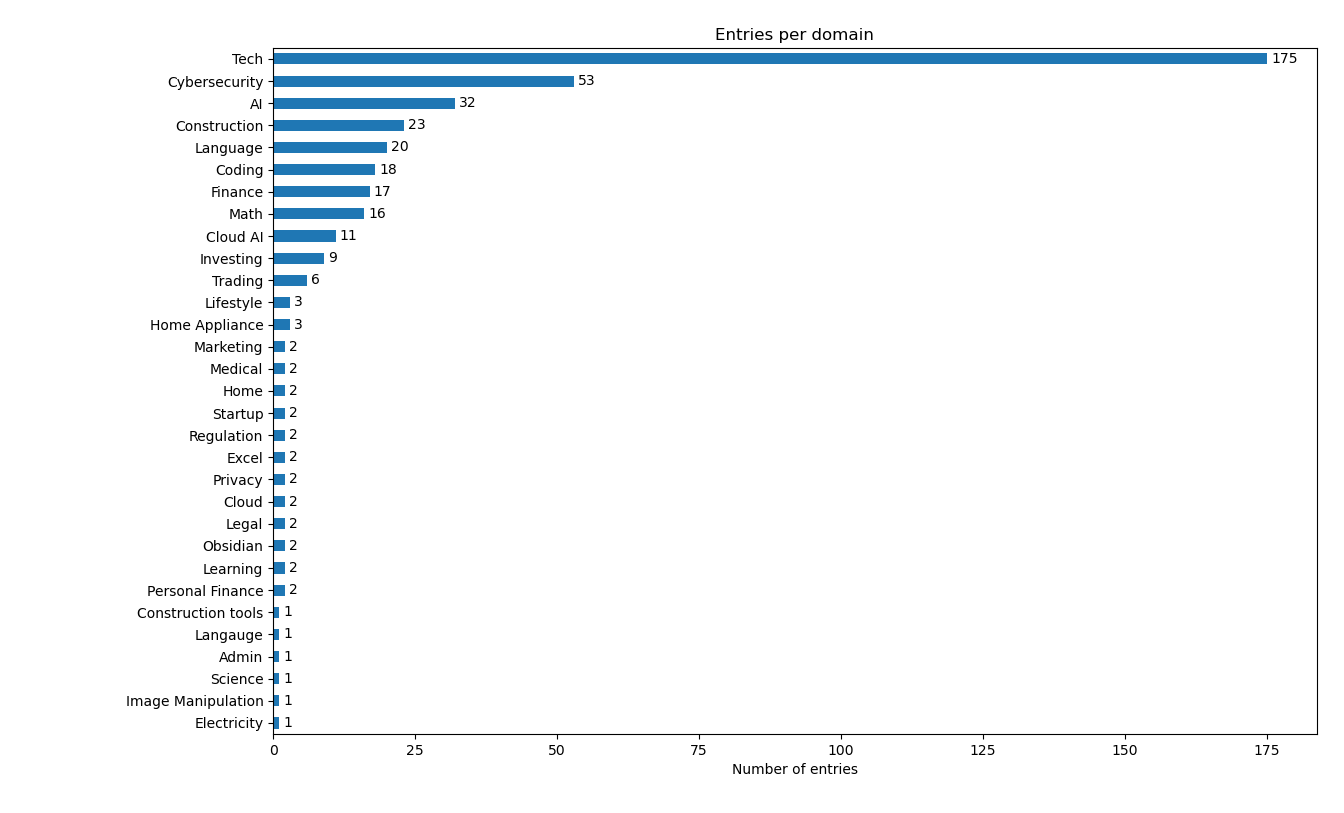
Up to 70 - 80% of my AI usage is on tech related topics. It’s not a surprising fact (for me), but it’s nice to see a figure that confirms it. It helps put my own subjective usage patterns into perspective. In this phase of my life, I rely on Claude heavily as a learning tool. In particular, I am treating Claude like an expert system - a teacher, almost, answering questions related to how something works, troubleshooting, clarifying about frameworks, libraries, etc. It has an incredible amount of ‘world knowledge’, and knows how to search the internet for what it lacks. I use it both to understand something for projects that I am working on, as well as a supplement tutor for certain subjects that I am learning. Prior to Claude, I would just be Googling all those things. But increasingly, both for simple “search”, or information retrieval functions, as well as reasoning functions, I am defaulting to Claude. Now, let’s take a look at the functional breakdown of my usage in detail:
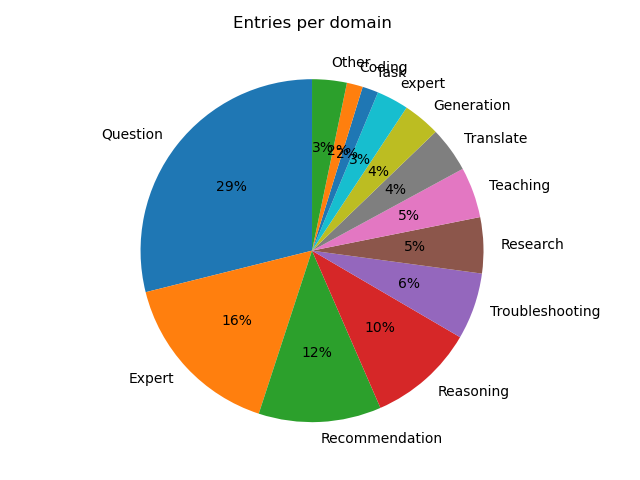
For 30% of the time, I expect Claude to be able to answer simple questions. This could involve a web search, or a tap on its existing world knowledge. Some 16% of the time, I am expecting it to have deep domain expertise and advise me on something very specific within a field. 12% of the time, I am asking it to give me recommendations based on its expertise. 10% of the time I ask it to perform reasoning tasks.
With everything apart from reasoning, the functions were fulfilled by Google before this. The difference is that if you were to use Google, these answers are one or N hops away. To get to your answers, you need to click on an arbitrary number of pages, deal with all the formatting quirks, noise, ads, etc. Not to mention frequently the discussion on the page is not relevant for you and you have to go back and forth between multiple pages.
When Google was all we had, retrieving information by hand seems all fine and dandy. Now, suddenly, in the face of a user experience which fed everything to you on a silver platter, search and self-retrieval suddenly feels laborious2.
So whilst the main use of Claude in my life is tech related, there are also a list of “long tail” categories in my engagement with it. For instance, there were times when I asked it questions relating to troubleshooting my washing machine or air con. When I had a persistent eye stye in Bali, I asked it for medical advice. And at times, I also ask it personal finance questions.
I think it’s fascinating that I am treating it as a real horizontal domain expert. It might not be the most credible or reliable, but for most domains, it can quickly help me get to a way deeper level of depth than previous technologies can. This is useful, at least, for a first pass. And having a quasi-expert that is always ready beats infrequent access to real experts. You can get things moving a lot faster.
It might seem obvious, but I realized that the domains I engage Claude for closely reflects the different phases of my interests. Scrolling down a sheet of all my prompts and seeing them cluster around specific periods of my life feels slightly trippy. Between Jan to Apr, it was a lot of deep leraning questions, as I was completing my course. June to Sep - construction. Sep to Nov: cybersecurity. It feels like time travel of sorts; or a walk down memory lane. It’s also a reminder that our usage of Claude is simply a substitute, or an extension, of what one is fascinated or preoccupied by at any point in time.
A question that I found myself debating internally from time to time is whether Claude is “simply better search”. On one hand, I think it is. For most people, perhaps the most common way Claude is used is as some kind of smarter search. However, I think there’s quite a lot to unpack by what one means by “better search”. On a system level, it’s clear that LLMs are the ‘reasoning’ layer that lies on top of search. They parse the ‘dumb’ responses returned by site indexers, and further condense information to better respond to the question. Instead of presenting each response back as a list of keyword matches ranked by popularity or relevance (what Google does), LLMs apply intelligence to the responses and provides the “last mile” cognitive delivery, connecting the dots for you, and perhaps even helping you reach certain conclusions. That’s what we mean by “better search”. There’s nothing quite trivial about this as well: first, it needs to retrieve the right information, then, it needs to synthesize the information, it needs to reason, and then decide whether it answers your question, before eventually summarizing its positions. If Google is a knowledge database, Claude (and LLMs) are knowledge agents. The difference between the agent and the database is that the agent does further post-processing and returns to you a refined knowledge product.
So for all the talk about fully automated agentic pipelines being the future, I think the main use case and killer application of AI is staring at us in the face: an intelligent reasoning engine that helps you parse, navigate informational spheres and expert domains. This is a proven use case for a majority of people, and it’s something that has not changed, and will not change.
In this sense, Claude is directly eating into Google’s share of the pie.
What about “tasks”?
Of course, the capacity of Claude does not stop here. If you want, you could even throw an entire problem to Claude, and ask Claude to do all the work and to solve it. It is smart enough, most of the time (in 2026 - in fact, since last year) to intuite what you need, and to provide some level of useful response. Case in point: vibe coding. Case in point: sometimes at work, I throw entire log files to Claude with no additional context and ask it to tell me what’s going on. Often, it gives me pretty good responses. It’s clear that in these cases, Claude is not just better search. It’s a worker. More than just a tool, it is a productive unit of labour itself.
This is happening, in fact, across vast swathes of the labour force, in varying degrees, at different speeds, and in unexpected ways at times. We are still in the process of adapting to it. But one thing that cannot be denied is that LLMs are a productivity workhorse.
If we were to break down jobs as a composite set of tasks, we can see how much of those tasks within a job can now be done by AI. Analysis, data crunching, information fetching, summarization, development - you name it. In most jobs, the actual tasks that is left for a human to do is a diminishing set. However, it’s important to make the distinction between implementation, and exercising judgement. Yes - the actual implementation of something can be done by the AI. But you still need someone who can ask the right questions, reason about the work, and communicate those reasoning. Most of the time, you realize that you are in dire need of “old school” domain expertise, precisely when implementation is cheap, being able to reason and analyze outside of the AI confines, being able to critique the AI outputs, becomes more expensive.
And it is precisely due of these reasons that most people are still struggling with adopting AI wholesale: just because Claude can perform a certain task doesn’t mean that it makes sense for it to. For instance, creatives might find that the works produced by Claude trite or that the workflow of interating upon something to be counter-productive to their creative processes. Engineers might find that vibe coded stack stack does not foster great engineering practices or motivation in the long run. Students may find that reliance on AI completely diminishes one’s efforts at deep and true understanding. My point is, it’s clear that people want to use AI as knowledge agents, and it is also clear that they want to rely on AI as a stand in for their own labour for certain tasks. But that boundary where AI labour and human labour meet is a constantly negotiated line that is not so clear at the moment.
The mistake in a bull cycle is to think that just because something can be solved by AI, means that humans will want to solve something via the AI approach. So far, in my life, I am witnessing the opposite. Personally, I am extremely wary of offloading my work, in bulk, to AI. I’ve seen it produce negative impacts on the quality of thought and work in the people around me. In the previous post, I’ve spoken about the double-edged sword that is AI. Engineers realize that the efficiency gains of AI is partially and sometimes significantly offset by the amount of tech and knowledge debt involved in catching up to the speed of development for AI workflows. At work, my boss tells us that we should think hard about pasting AI responses without validating them first. But the hidden paradox in all these cases is that at the end of the day, if we still need to expand considerable amount of effort checking the work, what’s the point of offloading the work in the first place? How do you exercise judgement without also accumulating domain expertise the slow way, through trial and error and doing things yourself?
Also, will we necessarily be happier?
Due to all of these, using AI as a complete substitute for labour, is largely still not the practice for most industries and roles. It could well be that the future of work will take the form of a human expert and AI labourer pair, where the role of a human expert is to validate, take responsibility for, and drive the output of a joint labour process. In fact, this future is already here for many jobs. It’s just a matter of degree.
Subterranean forces
So where does all these leave us?
I feel like there’s several facts about the state of the current times that is worth pondering about.
First, there’s never been a time where we can so easily traverse expert domains and knowledge graphs. I am imagining domain expertise as some kind of tree, where the root represents the general topic, and the leaves represent the niches within the domain. Previously, fields of expertise suffer from an accessibility problem. To get to particular leaves, often times we have to follow some kind of tutorial, or some kind of book, which define for us very static paths. Education is not “live”, in the sense that if there’s a branch in the path that we’re stuck at, it’s hard for us to recurse and get immediate feedback on which branches are missing from our conceptualization of a problem. Now, if we’re stuck at a branch, the AI can help reconstruct the knowledge the reasoning chain from first principal, all the way from the root to your specific branch. That’s akin to having a live tutor spotlighting different parts of a textbook you need to understand whenever you’re stuck on a problem. Its superpower as an educator lies in its instantaneous powers of knowledge path construction whenever you need it. The overall result is that understanding and traversing between domains become very very frictionless.
At the same time, there’s never been a time where machines can perform so many tasks, and that the tasks that they are able to do also seems like an exponentially expanding set. This has direct implications on both labour as well as the economics of labour.
Third, one would think that this would result in a situation where humans can afford to do less, think less, and work less. This could well be true in certain roles. For instance, if your job involved thrawling through thousands of lines of writing/logs/code to diagnose a problem, these things could be a lot easier in the age of AI. However, in many fields, the presence of AI has created new problems and new tasks to be done. I am thinking of cybersecurity where the increased capacity of AI hacking tools has created a situation where cyber defenders are forced to bring their A game because their adversary is very powerful. Open source repo maintainers have to deal with a deluge of pull requests that are vibe coded and are complaining of burn out. Senior software engineers have to deal with a higher volume of AI code churned out by junior devs. It seems like the trend is that as long as there’s some human that needs to verify the outputs of AI, having a very efficient bottom layer that produces outputs at machine speed just means that there will be a bottleneck at the top layer which checks at human speed.
Unless, of course, we also find a system where the AI does the verification; then, we’re truly fucked.
But in general, for many roles nowadays, it really seems like the jobs are more demanding, not less. Modern day cybersecurity involves understanding a vast corpus of tech stacks, their upstream dependencies, how they might break, how their continuous change and development in a dynamic enterprise environment - which, as a beast, is faced with its own set of competitive pressures, hype cycles, mania and depression - causes specific weaknesses, however temporal, whose neglect directly causes breaches. You notice a similar trend in software engineering, where the breakneck speed of production means that mistakes and poor fundamentals are quickly amplified.
So where does all these leave us? Yes, we can learn better; the machines are taking over; but the jobs are getting more demanding, and potentially, there’s also more work.
Net net? Lol.
If I remember correctly, May 2025 was around the period when Claude got seriously good and I switched over to Claude from ChatGPT. ChatGPT was not bad, but really obsequious and hallucinated more. But the core reason for my switch was really because people around me were raving about Claude and so I decided to give it a try ↩︎
I think there’s something to be said about what we lose when we don’t parse information and evaluate the veracity of sources ourselves. But that is a topic for another essay. ↩︎